
Your Oral Health Questions
Hydroxyapatite toothpaste: is it really an upgrade?
The short answer
Hydroxyapatite toothpaste can be a useful alternative, but it isn’t automatically better than fluoride toothpaste.
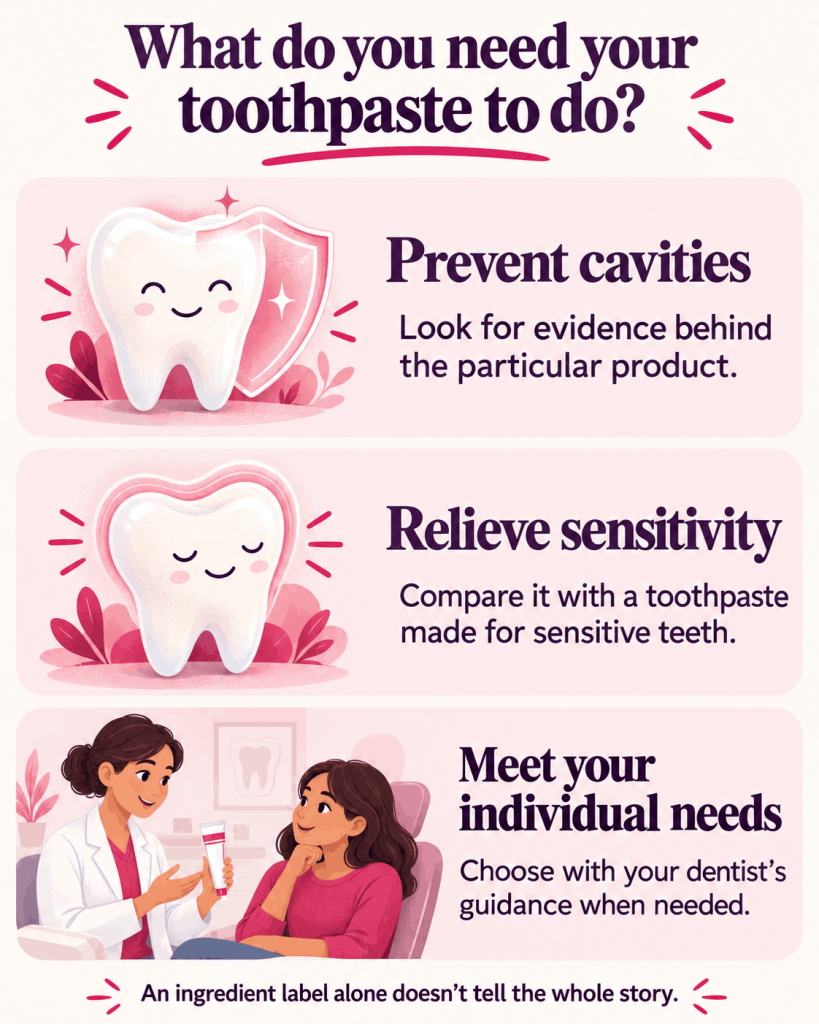
Some formulations have evidence supporting cavity prevention and sensitivity relief.
It may suit individual needs, including when your dentist recommends a fluoride-free option.
If your current fluoride toothpaste or sensitivity toothpaste works well for you, there’s no clear reason to switch simply for the hydroxyapatite label.
A closer look
What is hydroxyapatite?
Hydroxyapatite is a calcium-phosphate mineral closely related to the mineral that makes up tooth enamel. Toothpastes contain manufactured particles, sometimes described as “nano-hydroxyapatite” because of their small size.
That gives the ingredient a sound scientific rationale. However, containing a mineral found in teeth does not, by itself, make a toothpaste better.
How does it compare with fluoride for preventing cavities?
Some clinical trials have found that particular fluoride-free hydroxyapatite toothpastes performed comparably to fluoride toothpaste under the conditions studied.
For example, an 18-month adult trial found that the tested hydroxyapatite toothpaste met the researchers’ predefined criteria for being “not unacceptably worse” than a toothpaste containing 1,450 ppm fluoride. This is called a non-inferiority trial; it was not proof of superiority.
The study also had manufacturer funding. Its findings are useful, but should be considered alongside its design and limitations. Results for one formulation cannot automatically be applied to every hydroxyapatite toothpaste.
What about sensitive teeth?
Some hydroxyapatite formulations can reduce sensitivity by helping block the microscopic channels in exposed dentine.
However, the complete formulation matters. Studies have tested different concentrations and combinations of ingredients, with differing results.
The useful comparison is with an established sensitivity toothpaste—not simply an ordinary fluoride toothpaste. Relief from sensitivity also does not require a product to be fluoride-free.
When might it make sense to choose it?
Hydroxyapatite toothpaste may be a practical option when your dentist recommends a particular formulation for your needs, including when a fluoride-free alternative is appropriate.
If a toothpaste causes irritation, identifying the ingredient responsible is helpful. Flavourings, detergents or other ingredients may be involved; changing to fluoride-free toothpaste does not necessarily address the cause.
Is it worth switching?
Ask what you expect to gain: better sensitivity relief, improved tolerability, or another specific benefit.
If your current fluoride toothpaste or sensitivity toothpaste meets your needs, the hydroxyapatite label alone is not a compelling reason to change. If the alternative costs more, consider whether it offers a benefit that matters to you.
“Fluoride-free” describes what a product leaves out. It does not establish that the product is safer or more effective.
Choose a toothpaste for your needs, rather than the promise that newer means better.
Sources and further reading
Dr Mandana Donoghue
Dental Specialist (Oral Pathology)
Last reviewed: 31 October 2026