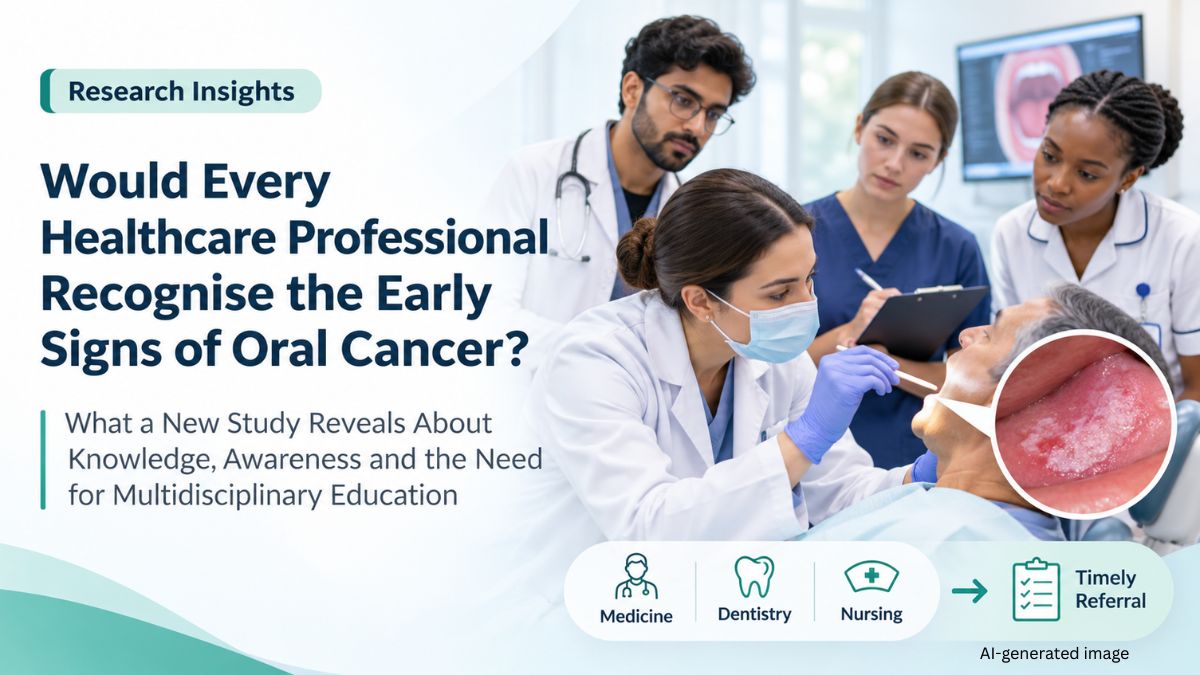
Would Every Healthcare Professional Recognise the Early Signs of Oral Cancer?
Beyond Awareness: Recognising Oral Cancer and Knowing When to Act
Oral cancer (OC) is a significant healthcare burden across the globe. It may arise in association with oral potentially malignant disorders (OPMDs), a group of clinical conditions associated with an increased risk of developing oral cancer. OPMDs may present with identifiable clinical and histopathological changes. Delayed recognition and diagnosis of oral cancer can contribute to substantial morbidity and mortality. This remains a major challenge despite advances in diagnostic and treatment approaches.
OC and OPMDs are often perceived as conditions that fall primarily within the domain of dental professionals. However, patients may not always present with suspicious oral lesions at a dental clinic. A persistent oral ulcer, unexplained mucosal lesion or neck swelling may first be noticed during a routine medical consultation, a nursing assessment or another healthcare interaction.
This raises an important question: Are healthcare professionals across disciplines adequately equipped to recognise the early signs of oral cancer and understand when further investigation or referral is warranted?
A multicentre cross-sectional study published in Frontiers in Oral Health by Khanagar et al. (2026) explored this question by assessing the knowledge, awareness, attitudes and practices regarding OPMDs and oral cancer among healthcare professional students in Riyadh, Saudi Arabia [1]. The findings provide an opportunity to reflect on how well future healthcare professionals are being prepared to contribute to oral cancer prevention and early detection.
What did the study aim to investigate?
The study, titled “Knowledge, awareness, attitudes and practice regarding oral potentially malignant disorders and oral cancer among health professional students in Riyadh, Saudi Arabia: a multicenter cross-sectional study,” aimed to assess undergraduate healthcare students’ reported knowledge, awareness, attitudes and practices concerning OPMDs and oral cancer.
The investigators focused on four domains:
- Knowledge: understanding of risk factors, clinical manifestations, diagnostic methods and treatment aspects.
- Awareness: familiarity with OPMDs and oral cancer and their clinical and preventive implications.
- Attitudes: perspectives towards oral cancer examination and patient counselling.
- Practices: questionnaire-reported behaviours relating to assessment and management of OPMDs and oral cancer.
How was the study conducted?
A multicentre analytical cross-sectional study was conducted among undergraduate healthcare students from five universities in Riyadh, Saudi Arabia. Data were collected between February and May 2026 through an anonymous online questionnaire using voluntary convenience sampling. The 32-item instrument was adapted from a previously validated questionnaire and underwent cultural and content validation by five experts in oral medicine, oral pathology and dental public health.
A pilot study involving 40 students assessed clarity and reliability; these students were excluded from the final analysis. The final survey included 456 participants:
| Discipline | Participants | Share |
|---|---|---|
| Medicine | 280 | 61.4% |
| Applied medical sciences | 100 | 21.9% |
| Nursing | 53 | 11.6% |
| Dentistry | 23 | 5.0% |
Descriptive statistics, chi-square tests, two-step cluster analysis and binary logistic regression were used to analyse the data [1].
What did the study reveal?
1. Knowledge varied across healthcare disciplines
The study identified two knowledge clusters: a higher-knowledge cluster (195 participants) and a lower-knowledge cluster (261 participants). Dental students and older participants showed higher levels of knowledge and more favourable responses across several measured domains. Medical students were more likely to belong to the higher-knowledge cluster than students from applied medical sciences.
However, only 23 dental students (5% of the total sample) participated. Therefore, findings regarding dental students should be interpreted cautiously and considered exploratory. The unequal representation of disciplines does not support a definitive ranking of professional curricula.
2. Knowing the risk factors did not always mean recognising the clinical signs
Participants in the higher-knowledge cluster were better at identifying OPMDs, risk factors and suspicious oral changes. Tobacco use was widely recognised as a risk factor, but recognition of certain clinical signs was less consistent. Knowledge level was not significantly associated with confidence in identifying lesions [1].
Understanding the risk factors for oral cancer does not necessarily mean being able to identify a suspicious lesion during a clinical examination. Theoretical knowledge, awareness and clinical recognition are related but distinct aspects of preparedness.
3. Awareness and attitudes were associated with better reported practices
Participants in the higher-knowledge cluster were approximately twice as likely to demonstrate high awareness. Those with high awareness had 3.53 times the odds of meeting the study’s good-practice threshold; those with positive attitudes had 5.10 times the odds. Knowledge-cluster membership alone was not significantly associated with good practice (p = 0.374) [1].
The findings suggest that theoretical knowledge alone may not be sufficient for clinical preparedness. Practical exposure, clinical experience and opportunities to apply knowledge are important educational considerations, although this study did not directly evaluate their effects.
From knowing to recognising—and knowing what to do next
The distinction between knowledge and clinical action is central to understanding these findings. A student may correctly answer a question about tobacco or leukoplakia yet be uncertain when examining a real patient, explaining an unexpected finding or choosing a referral pathway.
| Level of preparedness | What it involves |
|---|---|
| Knowing | Understanding risk factors, common presentations and why suspicious oral changes matter. |
| Recognising | Noticing an abnormality during an appropriate examination and appreciating that it warrants further assessment. |
| Acting | Communicating concern, arranging timely assessment or referral within professional scope, and supporting follow-up. |
What do these findings mean for healthcare education?
The study provides a valuable starting point for examining whether oral cancer education is adequately integrated into undergraduate healthcare curricula across different disciplines. The differences observed between professional groups may reflect variations in curriculum content, academic progression, prior training or clinical exposure. However, these factors were not directly assessed.
This raises an important question: should the recognition of suspicious oral lesions be incorporated more consistently into healthcare education?
What has other research found?
Evidence from other studies further highlights educational gaps, although their populations, questionnaires and scoring methods differ. The findings should be read as complementary perspectives rather than directly comparable measurements:
| Study | Relevant observation |
|---|---|
| Escoto-Vasquez et al. (2025) [2] | A systematic review and meta-analysis identified gaps in medical and dental students’ oral cancer risk-factor knowledge. |
| Petrauskienė et al. (2023) [3] | In this sample, medical students showed better knowledge of selected oral cancer risk factors than dental students. |
| Agarwal et al. (2024) [4] | Medical students showed stronger knowledge of causes and risk factors, while dental students were more aware of clinical signs and expressed greater interest in further education. |
| Mustafa et al. (2025) [5] | A study of clinical dental students explored awareness of oral cancer and OPMDs and the role of clinical-stage training. |
| Sharma and Wadhwan (2023) [6] | Identified differences in medical and dental undergraduates’ awareness and confidence regarding oral cancer recognition. |
| Sujir et al. (2024) [7] | Among 130 dental interns, good knowledge and practice scores coexisted with less favourable attitude scores, supporting the case for interprofessional learning. |
Collectively, these studies suggest that oral cancer education should extend beyond theoretical knowledge to include practical recognition skills, clinical exposure and interdisciplinary learning. Their different results also caution against assuming that one professional group consistently performs better across settings.
Who should recognise a suspicious lesion if the patient never visits a dentist?
Opportunities to identify suspicious oral lesions may arise in several healthcare settings. Dental professionals are positioned to perform comprehensive oral examinations, identify OPMDs, assess risk factors and initiate investigation or referral.
Physicians, nurses and allied healthcare professionals, particularly those working in primary care, may encounter patients with oral findings related to oral cancer and OPMDs. Depending on their scope of practice and training, awareness of suspicious findings and established referral pathways can contribute to coordinated care.
A healthcare professional who cannot diagnose an oral lesion definitively may still play an important role in recognising that it should not be ignored.
What might practical undergraduate training look like?
Oral cancer prevention and early detection could be incorporated into healthcare curricula through collaborative learning. Such initiatives may include:
- Practical workshops demonstrating appropriate oral examination techniques.
- Case-based recognition of suspicious lesions and key risk factors, including tobacco and areca nut exposure where relevant.
- Training in referral pathways, communication and follow-up between healthcare disciplines.
- Patient counselling exercises addressing risk reduction and the importance of timely evaluation.
- Observed or simulated assessments to test recognition and decision-making—not only recall of facts.
Interprofessional education may also encourage healthcare professionals to view oral health as an integral component of general health rather than an isolated clinical domain limited to dental professionals.
Strengths and limitations of the study
The study’s multicentre design and inclusion of multiple healthcare disciplines are important strengths. Its assessment of knowledge, awareness, attitudes and practices provides a broader perspective on students’ reported preparedness.
However, the cross-sectional design does not establish causal relationships, while self-reported data may be subject to recall and social desirability biases. Voluntary online convenience sampling may have introduced selection and nonresponse bias, as students with greater interest in oral cancer may have been more likely to participate.
The sample was unevenly distributed across disciplines and institutions. The study was restricted to healthcare students in Riyadh, limiting generalisability to other regions. Academic year, previous training and clinical exposure to oral lesions were not assessed, making it difficult to explain differences between disciplines. Institutional clustering was not accounted for statistically.
Most importantly, the survey assessed reported knowledge and practices rather than objective clinical performance. It cannot tell us how accurately students would recognise real lesions or whether a suspected cancer would be referred appropriately and without delay.
Conclusion: Recognising the signs is only the beginning
Would every healthcare professional recognise the early signs of oral cancer? The study identified variations in knowledge, awareness, attitudes and reported practices across healthcare disciplines, with dental students showing more favourable responses in several domains. However, these findings are exploratory because of the small dental subgroup (n = 23) and require confirmation in larger, more balanced studies.
The findings highlight the importance of strengthening oral cancer and OPMD education, practical training and interprofessional collaboration. Larger, representative multicentre studies, incorporating observed clinical assessments and appropriate statistical adjustments, are needed to validate the findings.
Integrating oral cancer education into multidisciplinary healthcare training may be a valuable step towards strengthening early recognition. Ultimately, the educational goal should be more than knowing the correct answer: it should be knowing when to act.
References
1. Khanagar SB, Alofi A, Alzaaqi LA, et al. Knowledge, awareness, attitudes and practice regarding oral potentially malignant disorders and oral cancer among health professional students in Riyadh, Saudi Arabia: a multicenter cross-sectional study. Front Oral Health. 2026;7:1942387. https://doi.org/10.3389/froh.2026.1942387
2. Escoto-Vasquez LS, Alarcón-Sánchez MA, Rodríguez-Montaño R, et al. Knowledge and awareness of medical and dental students about oral cancer risk factors: a systematic review and meta-analysis. Cancer Control. 2025;32. https://doi.org/10.1177/10732748251316603
3. Petrauskienė S, Kopczynska D, Žemgulytė G, Saldūnaitė-Mikučionienė K. Knowledge of oral cancer risk factors among international medical and dental students at the Lithuanian University of Health Sciences: a cross-sectional study. Healthcare. 2023;11(2):271. https://doi.org/10.3390/healthcare11020271
4. Agarwal S, Manaktala N, Natarajan S, Boaz K. Investigating oral cancer awareness among medical and dental students: a cross-sectional study in the South Canara region of India. ScientificWorldJournal. 2024;2024:8814749. https://doi.org/10.1155/tswj/8814749
5. Mustafa NS, Kashmola MA, Kasmoola S, Suhaimi SH. The level of awareness of oral cancer and oral potentially malignant disorders among clinical dental students at International Islamic University Malaysia. J Int Dent Med Res. 2025;18(1):259–267.
6. Sharma P, Wadhwan V. Appraisal of elementary knowledge and awareness of oral cancer among dental and medical undergraduates. Indian J Dent Res. 2023;34(3):312–316. https://doi.org/10.4103/ijdr.ijdr_1070_21
7. Sujir N, Ahmed J, Ramakrishna A, et al. Needs assessment for interprofessional education module on prevention and early detection of oral cancer among dental interns: a cross-sectional survey. BMC Oral Health. 2024;24:1351. https://doi.org/10.1186/s12903-024-05123-7
Tag:OPMD, Oral Cancer, Research