
Could Routine Dental Decisions Have Medico-Legal Consequences?
By Dr. Bhuvan Nagpal & Dr. Pranjali Mandurkar
Dental practice involves more than diagnosis and treatment. Everyday decisions concerning consent, documentation, prescriptions, referrals, communication and the management of complications can also carry professional, ethical and medico-legal consequences.
Many medico-legal concerns arise not from unusual situations, but from ordinary decisions made during routine practice.
How confident are you that your everyday clinical processes are also medico-legally sound?
When might a signed consent form not be enough?
Informed consent is a process of communication—not merely a patient’s signature on a form.
But how much information should be provided? Which risks need to be discussed? How should alternatives or the consequences of refusing treatment be explained? And when should consent be obtained again?
These questions become particularly important when treatment does not proceed as expected.
What makes a clinical record legally defensible?
Clinical records support continuity of care and patient safety. They may also become central to a complaint, insurance assessment or legal proceeding.
Would another professional reviewing your records months later understand the patient’s condition, the options discussed, the decisions made and the reasons behind them?
What is omitted from a record can sometimes become as important as what it contains.
When could delayed referral become a medico-legal concern?
Not every condition can—or should—be managed within a general dental practice.
Persistent symptoms, suspicious lesions, unexpected findings or a condition beyond the dentist’s competence or available facilities may require further investigation or specialist referral.
But when should a dentist continue to observe, when should further investigations be requested, and when could a delay in referral become difficult to defend?
How should a complication be communicated and documented?
Even appropriately performed treatment can result in a recognised complication or an unfavourable outcome.
What happens next may be critical. How should the patient be informed? What should be recorded? When is referral required? And how should the dentist respond if the patient is dissatisfied?
Clear communication and appropriate documentation can influence both patient care and what happens if the event is later reviewed.
What distinguishes a recognised complication from professional negligence?
An unfavourable outcome, by itself, does not establish negligence. Biological variation, patient-related factors and recognised risks can all influence treatment outcomes.
The distinction may depend on several interconnected factors: the expected standard of care, whether the risk was foreseeable, what the patient was told, the precautions taken, how the complication was managed and what was documented.
Understanding a general principle is one thing. Applying it correctly to a real clinical situation can be far more complex.
Medico-legal awareness is not about practising defensively or anticipating a complaint after every procedure. It is about developing habits that support patient safety, clear communication, sound clinical judgment and legally defensible dental practice.
Explore These Questions in Greater Depth
Join Dr. Bhuvan Nagpal, Dental Medico-Legal Consultant, Medical Second-Opinion Expert and Founder-Director of RJML2, for:
Medico-Legal Implications in Routine Indian Dental Practice
A Basic Introduction for Every Dentist
The live online course will explore informed consent and informed refusal, clinical documentation, prescriptions, referrals, communication, complications, adverse events, patient dissatisfaction and professional risk management within the Indian dental context.
Date: Friday, 16 October 2026
Time: 7:00–9:00 PM IST
Format: Live online via Zoom
Course fee: ₹450
Recording access: At least three months
Certificate: Certificate of Completion after fulfilling the course requirements
Suitable for dental students, interns, postgraduate students, recent graduates, practising dentists, specialists and faculty members. No prior legal training is required.
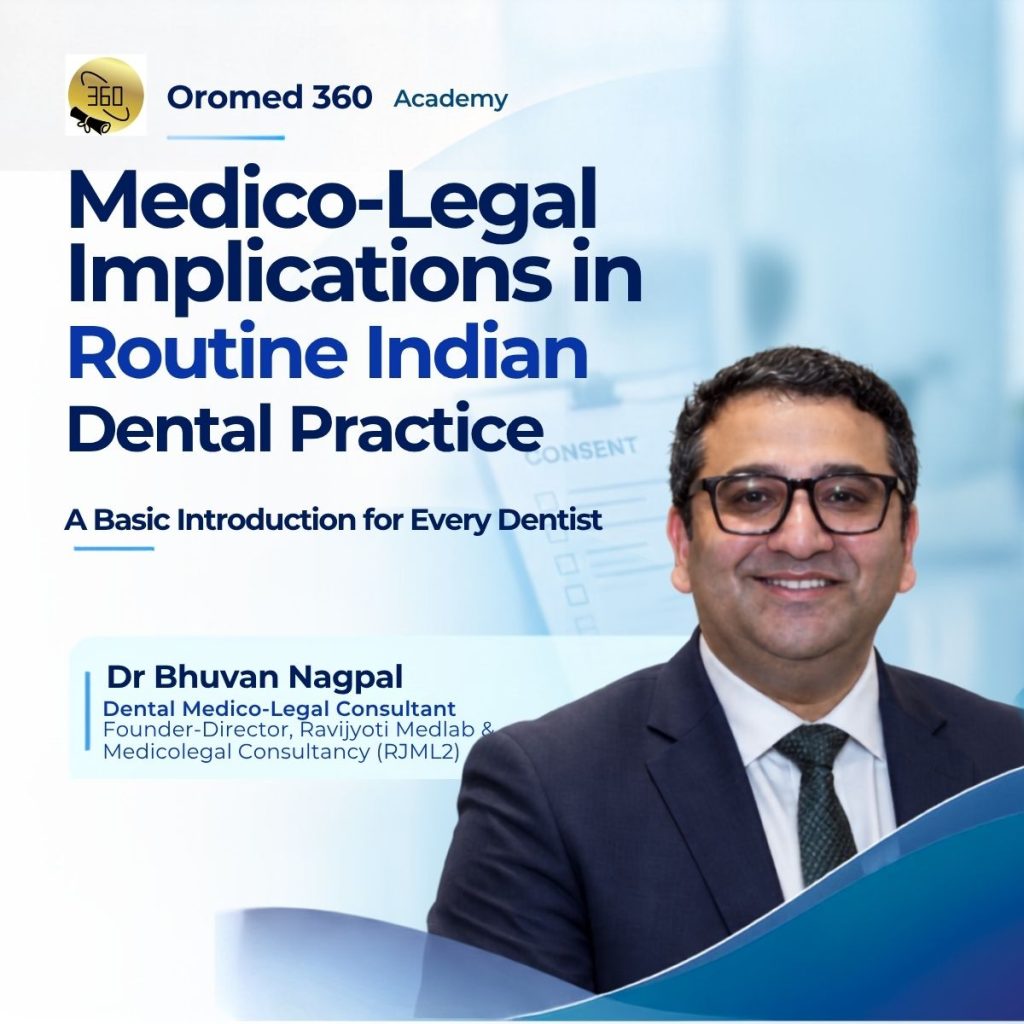
Medico-Legal Implications in Routine Indian Dental Practice
A practical live online course introducing the essential medico-legal responsibilities involved in routine Indian dental practice.
16 October 2026 | 7:00–9:00 PM IST | Live on Zoom
Includes recording access and a Certificate of Completion.
India: INR • International: USD
This article and course are intended for general educational purposes and do not constitute case-specific legal advice.

You may also like

Stress and Burnout in Healthcare: Why It Matters